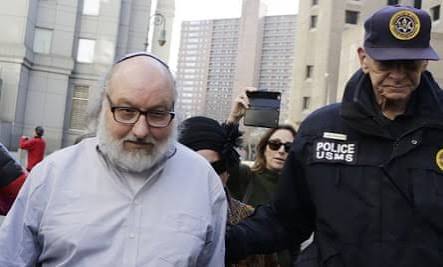

Jonathan Pollard sold America’s secrets, served thirty years for it, and never apologized. Then a United States ambassador hosted him at the U.S. Embassy — and the president stood by the ambassador.
On December 30, 2020, a Boeing 737 belonging to Sheldon Adelson’s Las Vegas Sands landed at Ben Gurion Airport carrying Jonathan Pollard and his wife, Esther. The Associated Press matched the jet’s livery and flight path; Israel Hayom had reported the flight was arranged for Esther’s medical needs. Waiting on the tarmac was the prime minister of Israel. Benjamin Netanyahu handed the Pollards their Israeli ID cards and told them, “You’re home.” Pollard kissed the tarmac and said, “We are ecstatic to be home at last after 35 years.”
Thirty-five years. That is one way to count it. The United States counts it differently: it counts the years since a Navy intelligence analyst walked out of his office in Suitland, Maryland, with suitcases full of America’s secrets and sold them to a foreign government.
Pollard was a civilian analyst with a Top Secret/SCI clearance, assigned in June 1984 to the Navy’s Anti-Terrorist Alert Center. Over roughly seventeen months, according to the CIA’s damage assessment — declassified in 1987 and released in fuller form in 2012 — he passed Israel more than 800 classified documents and some 1,500 intelligence messages. His handlers were officers of LAKAM, a covert Israeli scientific-intelligence unit run by Rafi Eitan; the recruiter was an Israeli air force colonel named Aviem Sella. Israel paid Pollard a monthly salary for the work.
The inventory is the part no one should skim. The NSA’s ten-volume RASIN manual — the bible of American signals intelligence. Iraq’s and Syria’s chemical weapons programs. Soviet arms shipments to Syria. Pakistan’s nuclear program. Egyptian missiles, Libyan and Tunisian air defenses, the MiG-29. And, by Pollard’s own account in a 1987 interview with Wolf Blitzer, the satellite photographs of the PLO headquarters in Tunis that Israel used for its October 1, 1985 bombing raid, Operation Wooden Leg. He did not sell secrets about an enemy. He sold the crown jewels of the country that employed him, to a country that calls itself America’s closest ally.
When the FBI closed in, Pollard and his wife ran to the one door they believed would open: the Israeli Embassy in Washington. On November 21, 1985, the ally he had served turned him away at the gate, and FBI agents arrested him outside it. He pleaded guilty in June 1986 to conspiracy to deliver national defense information. His plea agreement was supposed to spare him the maximum. On March 4, 1987, Judge Aubrey Robinson sentenced him to life anyway — after reading a 46-page classified declaration from Secretary of Defense Caspar Weinberger. “It is difficult for me, even in the so-called ‘year of the spy,’” Weinberger wrote, “to conceive of a greater harm to national security than that caused by Mr. Pollard’s treasonous behavior.” It remains the only life sentence ever imposed on an American for spying for an ally.
“It is difficult for me, even in the so-called ‘year of the spy,’ to conceive of a greater harm to national security.”— Caspar Weinberger, Secretary of Defense, to the sentencing court, 1987
Four former directors of Naval Intelligence have called Pollard a “greedy, arrogant betrayer of the American national trust.” In 1998, seven former Secretaries of Defense signed on against his release. That is the American file on Jonathan Pollard, and it has never been revised.
Israel’s file is a different document. Jerusalem first insisted Pollard was a rogue operation it knew nothing about. Then, in November 1995, Israel granted him citizenship. In May 1998, Netanyahu’s government formally admitted what it had denied for thirteen years: Pollard had been an Israeli agent, run by an Israeli unit, on Israeli orders. Five months later, at the Wye River peace talks, Netanyahu pressed President Clinton for a pardon — by both men’s own memoirs, Netanyahu told Clinton that if he signed an agreement with Arafat, he expected Pollard freed. CIA Director George Tenet reportedly threatened to resign if it happened. It didn’t.
Pollard was paroled on November 20, 2015, after thirty years, with conditions: remain in the United States, a 7 p.m. to 7 a.m. curfew, a GPS monitor on his wrist, his computers monitored. Five years later, on November 20, 2020, the U.S. Parole Commission let the parole expire at its natural end, finding, in the commission’s words, “no evidence to conclude that he is likely to violate the law.”
Get this part exactly right, because it is routinely gotten wrong: Donald Trump never pardoned Jonathan Pollard. The parole clock ran out under a commission’s decision. What Trump did do — on January 20, 2021, his final day in office — was pardon Aviem Sella, the Israeli colonel who recruited Pollard. The spy’s freedom arrived by calendar. The handler’s arrived by presidential pen.
And Pollard himself? He has never expressed a word of regret, and he says so proudly. “I don’t regret helping my people and my land,” he told interviewers in 2021, in a rare interview with Israel Hayom. Asked about dual loyalty, he did not bother to deny it: “The bottom line on this charge of dual loyalty is, I’m sorry, we’re Jews, and if we’re Jews, we will always have dual loyalty.” He said his loyalty is “to the Jewish people and the Jewish state,” and that if a young American Jew working inside the U.S. security apparatus asked his advice, he would counsel him to spy: “You have to make a decision whether your concern for Israel and loyalty to Israel and loyalty to your fellow Jews is more important than your life.” In August 2025, he framed it as doctrine: “Just as certain members of the Trump administration profess an ‘America First’ doctrine, I wholeheartedly embrace an ‘Israel First’ doctrine. And I went to jail for that for 30 years.”
Israel, for its part, treats him the way nations treat their heroes. Jerusalem renamed Paris Square “Freedom for Jonathan Pollard Square.” A synagogue in East Jerusalem bears his name — AFP has described his standing there as “a combination between a hero and a martyr.” A 2013 petition for his release gathered 100,000 signatures. Netanyahu visited him in prison in 2002, when almost no one in Israel’s establishment would yet be photographed doing it, and was waiting on the tarmac in 2020 when the favor was finally returned.
Which brings the story to July 2025, and to a meeting the American public learned about four months after it happened. Mike Huckabee, Trump’s ambassador to Israel, hosted Jonathan Pollard inside the United States Embassy in Jerusalem. The New York Times, which revealed the meeting on November 20, 2025, reported it was kept off the ambassador’s official schedule, that the White House had not known in advance, and that the encounter alarmed the CIA’s station chief in Israel. The embassy dismissed the Times story as “filled with inaccuracies.” Pollard himself confirmed the meeting and said he had requested it, telling i24 News and the Jerusalem Post he wanted “to express my deep and sincere appreciation for everything he had done to help me when I was in prison.”
Huckabee had, in fact, done a great deal. He had publicly advocated for Pollard’s release as far back as 2011. In February 2026, sitting across from Tucker Carlson, he owned all of it: Pollard “served an extraordinary length of time,” clemency would have been “a good faith gesture,” and as for the embassy meeting — “I simply met with him… frankly, I don’t regret it.” The White House’s response, from press secretary Karoline Leavitt, was this: “the president stands by our ambassador, Mike Huckabee, and all that he is doing for the United States and Israel.”
Not everyone stood by it. “This is shocking behavior from a United States ambassador,” Carlson said. “Is Huckabee going to explain it?” Steve Bannon called for Huckabee to be recalled and said he was “out of control.” Representative Joaquin Castro was bluntest: “Jonathan Pollard is a convicted traitor… It’s unacceptable that Ambassador Huckabee secretly met with Mr. Pollard… at the United States Embassy.” Daniel Kurtzer, a former U.S. ambassador to Israel, said the meeting “just defies any kind of logic” and that there is “no reason to rehabilitate him.” The outrage crossed every line American politics has — and changed nothing.
Then, in October 2026, the Times reported something larger: that Huckabee’s senior adviser, David Milstein — who had also been involved in the Pollard meeting — spent the year suppressing or rewriting the embassy’s own reporting when it reflected badly on Israel. Fifteen current officials, nine former diplomats, and dozens of documents stand behind the investigation: a March 2026 cable warning about settlement expansion and annexation, blocked; reporting on settler violence, replaced with a cable praising Israel for “cracking down”; an embassy report on nine killed Palestinian-Americans, requested by thirty members of Congress, blocked; casualty figures from the Gaza Humanitarian Foundation, stripped; a famine cable, blocked. Huckabee denied it in writing — “I personally and comprehensively deny the elements of your fabricated ‘story’” — and floated a defamation suit. Senator Chris Van Hollen wrote to the Senate Foreign Relations Committee demanding a hearing, saying Huckabee and Milstein “have become apologists for the most extreme Israeli government in history.” Those are allegations, contested ones, and they are labeled as such here. What is a fact is narrower and, in its way, louder: as of this writing, the president has said nothing about them at all.
One more thing this article will not tell you, because it cannot be proven: the darkest claim in the Pollard file — that Israel traded his material to the Soviet Union — rests on Seymour Hersh’s 1999 reporting, and Hersh’s own text concedes American officials had “no hard evidence — no ‘smoking gun.’” It is graded here as alleged and disputed, and anyone who states it as fact is selling you something. The documented record is damning enough without it.
This spring, Pollard decided the hero’s welcome should become a political career. On May 5, 2026, he announced a run for the Knesset with a new list, Lights of Dawn, and stated his platform to Channel 13 in one sentence that should be read slowly: “I personally prefer the forcible removal of all current residents of Gaza, and the annexation of Gaza and its repopulation by us.” He has also, in podcast remarks circulated from a May 2026 interview, urged nuclear escalation against Iran: “I don’t care if you start throwing nukes immediately — responsibly, but immediately.”

Israeli voters were not interested. Pollard left Lights of Dawn and, in August, posed at the Western Wall with Sharren Haskel’s Israel First — she called his endorsement “a significant boost” while publicly rejecting his Gaza position as party policy. When Israel First filed its official slate in September, Jonathan Pollard’s name was not on it. He was never a candidate at all. On October 27, Israel First received 955 votes — 0.02 percent — and no seats. The man who was greeted at the airport by a prime minister could not persuade a thousand Israelis to vote for the party he posed with.
So here is what actually happened. In 1985, Jonathan Pollard begged for shelter at an embassy gate in Washington, and the gate stayed closed. In 2025, an embassy gate in Jerusalem opened for him, he was welcomed inside by the ambassador of the country he betrayed, and the President of the United States stood by the man who opened it. Pollard never changed. His file never changed. The only thing that changed is what Washington is willing to honor.
Sources: CIA damage assessment, declassified 1987 / released 2012 (National Security Archive) · Caspar Weinberger, classified declaration to the sentencing court, 1987 · Associated Press, parole completion and arrival reporting, Nov–Dec 2020 · Reuters, “White House was unaware US ambassador to Israel met with convicted spy,” Nov 20, 2025 · The New York Times, Huckabee–Pollard meeting (Nov 20, 2025) and embassy reporting investigation (Oct 8, 2026) · Israel Hayom interview, Mar 25, 2021 (via Times of Israel / JTA) · Jerusalem Post, Aug 2025 and Nov 2025 · The Guardian (Julian Borger), May 5, 2026 · Tucker Carlson interview with Mike Huckabee, Feb 2026 · Sen. Chris Van Hollen, letter to the Senate Foreign Relations Committee, Oct 9, 2026 · Israel Central Elections Committee, final results, Oct 30, 2026 · Seymour Hersh, The New Yorker, Jan 18, 1999 (Soviet-trade claim, graded disputed).
Leave a Reply