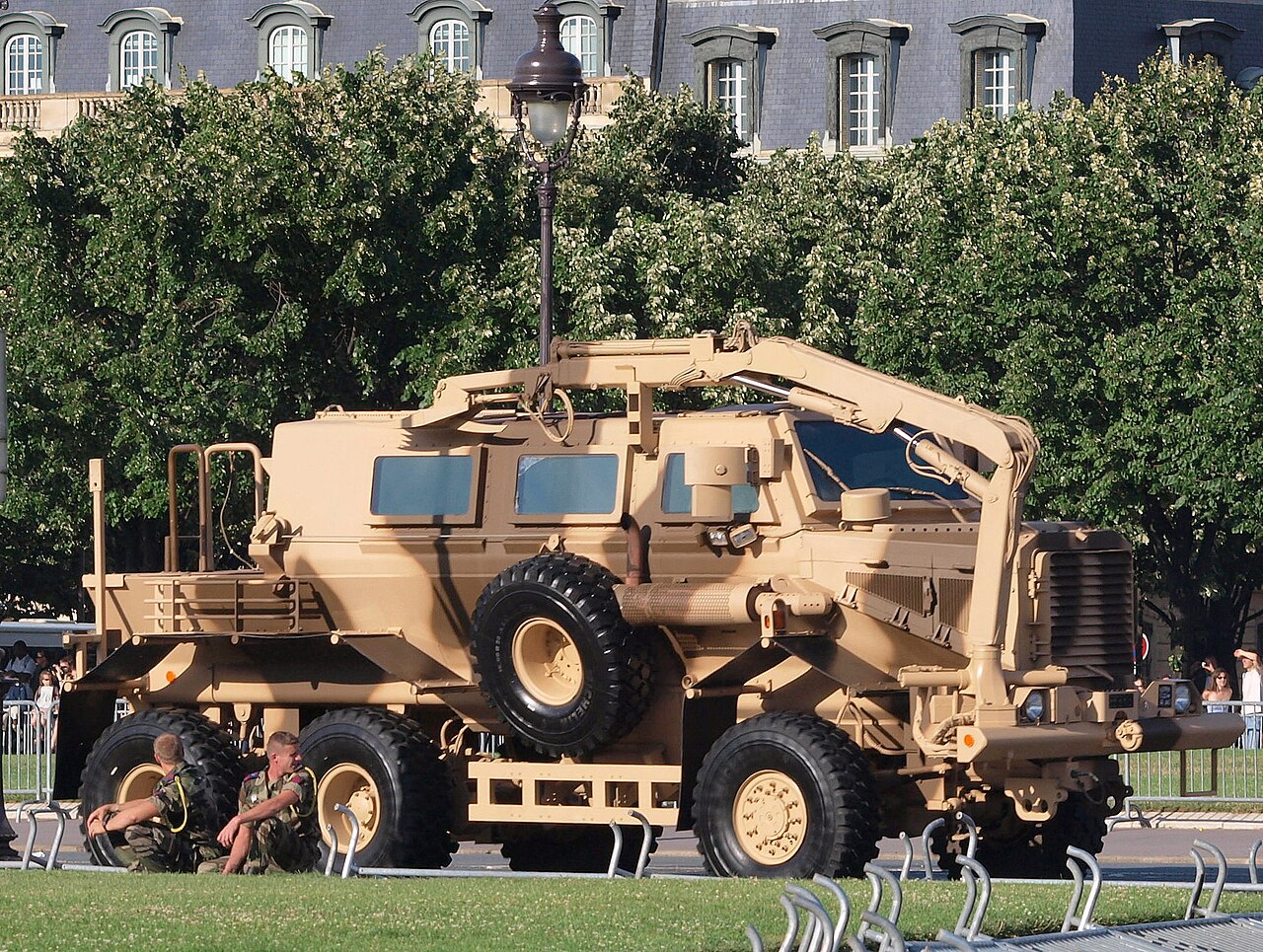

A Buffalo MRAP vehicle. Photo via Wikimedia Commons (CC0).
Federal surplus logs and municipal budgets reveal how combat hardware and tactical optics tested in foreign war zones are systematically channeled into small-town Pennsylvania police departments.
Municipal police departments and county sheriffs across Pennsylvania have acquired tens of millions of dollars in military-grade assault rifles, infrared night-vision optics, and heavy armored combat vehicles through federal surplus transfers, according to public inventory ledgers maintained by the Defense Logistics Agency’s Law Enforcement Support Office.
While the transfer of military equipment to civilian police is frequently framed as the harmless distribution of obsolete government property, public records reveal an active commercial and ideological pipeline. Defense contractors develop tactical surveillance arrays, specialized weapon optics, and armored carriers for overseas combat theaters, leveraging battlefield testing to establish commercial credibility. Through the Pentagon’s 1033 Program and Department of Homeland Security grants, this combat hardware is funneled directly into rural townships and quiet borough departments with negligible violent crime—quietly shifting domestic policing doctrine from community peacekeeping toward military occupation while leaving local taxpayers to fund recurring maintenance costs.
The Local Footprint: Military Rifles in the Bloomsburg Cluster
A review of the Defense Logistics Agency (DLA) 1033 Program inventory reveals that even rural communities and university towns in central Pennsylvania maintain military-specification infantry weaponry.
In Columbia County, official logs document the transfer of military 5.56mm semi-automatic rifles (M16/M4 military specification) to small township departments encircling the town of Bloomsburg:
-
Scott Township Police: 5.56mm military rifle
-
Hemlock Township Police: 5.56mm military rifle
-
Locust Township Police: 5.56mm military rifle
-
Montour Township Police: Tactical ballistic entry shield
-
Bloomsburg Police Department: 20 military cartridge magazines
In communities where violent crime is statistically rare and police forces consist of only a handful of officers, the operational justification for military assault rifles remains unexamined. Instead of responding to verified tactical threats, small departments routinely request military hardware simply because the federal government makes it available for a nominal transfer fee.
Regional Surveillance & Night-Vision: Luzerne, Lackawanna, and Northumberland
Moving into the Interstate 81 and Susquehanna River corridors, federal transfers escalate from standard infantry rifles into sophisticated infrared surveillance assemblies and heavy military utility trucks.
In Luzerne County, the Sheriff’s Department acquired over $27,500 in specialized combat hardware, led by five non-inverting infrared night-vision telescopes valued at $23,645, ten reflex weapon sights ($3,310), and four 7.62mm M14 battle rifles. Nearby borough departments in Exeter and Sugar Notch also added 5.56mm rifles to their municipal armories.
In Lackawanna County, the Carbondale Police Department secured nine military rifles (seven 5.56mm and two 7.62mm rifles) along with 25 tactical magazines. Meanwhile, residential suburban departments in Dunmore, Covington Township, and Jefferson Township each acquired heavy military utility trucks valued at over $41,000 apiece, and Roaring Brook Township added tactical night-vision sight assemblies.
In Northumberland County, municipal departments in Mount Carmel Borough and Mount Carmel Township received infrared surveillance subassemblies, tactical binoculars, high-powered telescopes, and ten weapon-mounted laser aiming units, while the Milton Borough Police Department acquired tactical weapon laser pointers. Even state regulatory agencies joined the surplus pipeline: the Pennsylvania Fish and Boat Commission acquired 96 reflex weapon sights valued at $32,640 and five personnel parachute harnesses.
Battlefield Armor on Main Street: The $733,000 MRAPs
The most extreme entries in Pennsylvania’s 1033 inventory are heavy armored combat vehicles engineered specifically to withstand landmines and improvised explosive devices (IEDs) in Iraq and Afghanistan.
Multiple small-town and suburban Pennsylvania police departments have taken possession of 15-ton Mine-Resistant Ambush Protected (MRAP) vehicles valued at over $733,000 each:
-
Center Township Police Department (Beaver County): $733,000 MRAP vehicle
-
Pottstown Police Department (Montgomery County): $733,000 MRAP vehicle and 25 reflex sights (serving a borough of 23,000 residents)
-
New Britain Township Police (Bucks County): $689,000 armored vehicle, dual thermal weapon sights ($22,507), and 24 reflex sights
-
Chester Police Department (Delaware County): $733,000 MRAP, military reconnaissance camera systems ($10,294), and 20 chemical-biological gas masks
Beyond wheeled MRAPs, several Pennsylvania agencies acquired full-tracked combat personnel carriers. The Stroud Area Regional Police in Monroe County obtained an M113 full-tracked armored personnel carrier valued at $244,844, while Bucks County South Central Emergency Response Team acquired two tracked combat carriers valued at nearly half a million dollars ($489,688). In Bucks County, the Newtown Township Police Department took custody of a 107mm mortar carrier chassis valued at $205,400 alongside ten M16 rifles.
The “Free” Hardware Trap and Doctrinal Drift
While municipal officials frequently justify acquiring 1033 gear by claiming it comes at “no cost to local taxpayers,” public budget analyses expose this as an illusion. The hidden costs of militarization are substantial:
-
Maintenance & Fuel: Operating and maintaining a 15-ton, specialized armored combat vehicle requires bespoke mechanical parts, commercial freight transport, and high-volume diesel consumption that municipal budgets must absorb once the transfer is complete.
-
Liability & Training: Municipal insurance carriers frequently raise liability coverage premiums for departments deploying heavy tactical armor. Furthermore, officers must undergo specialized tactical training to operate military-grade optics and assault weaponry.
The deeper danger is psychological and doctrinal. When police departments are equipped like light infantry units, they inevitably adopt the mindset of an occupying force. Criminological studies confirm that departments possessing surplus military equipment deploy SWAT teams significantly more often, predominantly for low-level drug searches, consensual warrants, and routine traffic operations. By blurring the line between domestic civilian law enforcement and foreign military combat, the federal surplus pipeline erodes the constitutional protections of the communities it claims to protect.
Sources
Official federal surplus and procurement ledgers:
-
Defense Logistics Agency (DLA), Law Enforcement Support Office (LESO), “1033 Program Public Information: Tactical and Controlled Property Ledgers”, U.S. Department of Defense.
-
Federal Emergency Management Agency (FEMA), “Authorized Equipment List (AEL) for State and Local First Responders”, U.S. Department of Homeland Security.
Oversight and investigative reports:
-
U.S. Government Accountability Office (GAO), “Controlled Military Equipment: Actions Needed to Address Weaknesses in DOD’s Oversight of Law Enforcement Support Office Transfers,” Report GAO-17-532.
-
LevittownNow / PA Freedom of Information Act Consortium, “See What Pennsylvania Police Got From the Pentagon 1033 Program”, Public Records Analysis.
Local municipal & county budgets:
-
Columbia County Commissioners & Municipal Police Department Expenditure Records.
-
Luzerne County and Lackawanna County Adopted Public Safety Budgets.
Leave a Reply